Thursday, 26 January 2012

Camerawork

Camera Distance:Close up- A shot taken very close to the subject, often a person's head or other significant object, which fills the screen.
Establishing shot- Usually a long shot that establishes the spatial relations between figures, objects and the setting of the film or scene.
Extreme close up- A shot in which the scale of the object is even larger, as when a small object, detail or  body part (face, eyes, etc.) fills the screen.
Extreme long shot- The subject is extremely small in relation to the size of the screen; frequently an interior establishing shot.
Long shot- A shot in which the object shown is small in relation to the size of the screen; frequently an interior establishing shot.
Medium close up- A shot framing the human figure from the chest up.
Medium long shot- A shot framing the human figure from the knees up.
Medium shot- A shot framing the human figure from the waist up.


Camera Movement:
Paranoma shot- The camera rotates from a fixed position along a horizontal plane.
Swish pan- The camera moves very rapidly along the horizontal plane so that the action appears blurred.
Tilt- The camera tilts up or vertically.
Tracking shot- The camea travels in any direction. The camera can be mounted on a truck or dolly to permit high speed movement.

Editing

Axis match: This is when the angle of the camera is in relation to the object on the screen, this remains the same from shot to shot.
Cross-cut: This is when two different shots of different action and places are put together simultaneously, they are usually related.
Direction match: The direction of a person or object that is the same throughout cuts.
Dissolve: This is when one shot gradually disappears and the next shot gradually appears.
Duration and pacing: The rhythm and duration of scenes and shots.
Eye line match: A cut of two characters within different shots that appear to be looking at one another due to the direction of the way they are looking.
Fade in: The gradual lighting of an image from dark (black) to light.
Fade out: The gradual darkening of an image.
Graphic match: Juxtaposition of graphically similar images.
Iris in: When an image is gradually shown from blackness through an expanding circle.
Iris out: This is the reverse of the iris in.
Jump cut: A break or jump in time, caused by removing a section of a shot and then splicing together what remains of it; on-screen the result is often jerky.
Movement match: Action that starts in one shot and continues onto the next shot.
Parallel cut: Editing that alternates shots of two or more areas of action occurring in two different places, usually simultaneously, that often run together later in the narrative.
Straight cut: Two shots that are joined together with no obvious continuity.
Wipe: One image is gardually replaced by another at a boundary that moves across the frame. This boundry is often a straight line, which moves vertically across the screen (but may also take other directions and shapes.

Monday, 23 January 2012

AS thriller title sequence order and structured

Order of things appearing in our sequence:
  • Footage
  • Music
  • Credits
A general rule of credit conventions:
  • Production companies and backers
  • Director
  • Producer
  • Executive producer
  • Top billed actors
  • Movie title
  • Other cast members
We then moved on to analyse a few title sequences- there order and how they are structured.


Lord of war-
  • Footage
  • Music
  • Credits (Top bill characters and title come first, and then other cast members names)
History of violence-
  • Footage (starts slow paced- an introduction in characters with a conversation)
  • Titles appear over footages- slow fade in and out
Heat-
  • Credits on a blank screen- the main titles.
  • Warner brothers then appears on screen
  • The titles appear to be fading

Sunday, 22 January 2012

Moodboard


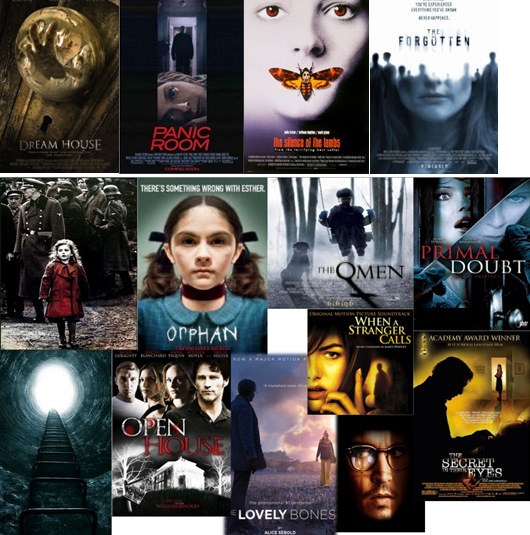
Within pictures such as 'lovely bones', 'secret in their eyes' and 'panic room' there has been a use of  silhouette. We decided that by looking at the use of silhouette we would be able to decide whether or not it would work best for our title sequence. Silhouetting is used to create a sense of eeriness and mystery.
For font, we looked at the writing used for 'The Orphan' which looks like very scratched naturalistic writing, the fact that it is such a scratched font gives an almost grusome feel.
Within the film 'Schindlers list' there is only one piece of colour within the whole of the film- the little girl with the red coat. The fact that it is on a young girl suggests that the colour could be a connotation of innonce, towards the end the coat is on a pile of dead bodies which suggests that there is no longer any innocence. We decided to use this aspect within our title sequence, by having one colour in bold means that the audience have a particular thing to concentrate on.
Also the use of mirroring is something that is used throughout many thrillers; 'dream house' and 'primal doubt' both use a type of mirroring. By doing this it creates a large amount of suspense as the audience try to figure out what the reflection is of.

Friday, 20 January 2012

Initial Idea's for our thriller title sequence

When starting our thriller sequence, it was important to first consider the different codes and conventions that can be found within the genre of a thriller.
These codes and conventions can include a range of different things including:


  • Low key lighting
  • Shadows
  • Music
  • Obstructive editing
  • quick cuts
  • Flashbacks
  • Black and white
Low key lighting-
Lighting used within a thriller is important as it can establish the mood of the scene and by having a contrast between dark light areas this creates deep shadowing for the shot.
Shadows-
Shadows are very similar to low key lighting in that they can effect the mood of the scene. However they can be used to show the possible darkness of a certain character, but also to add a sense of tension and eeriness.
Music-
Different music can do have different effects on films. Music within a thriller is supposed to create suspense and tension, this can be done by the pace of the music as a quicker pace would have a build up on the scene which would have a build up for the audience. This can also be created by orchestral music.
Obstructive editing-
This type of editing is used within thrillers frequently to accentuate the feelings of suspense and tension, particularly used within an extremely important scene of the film.
Quick cuts-
As these are particularly fast paced cuts this means that the reaction of the audience will also be very quick as they begin to relate to the emotional side of the film or of the character.
Flashbacks-
A flashback within a thriller usually gives a sense of disorientation which then means that the audience become puzzled by the events taking place.
Black and White- 
Black and white is also like low key lighting and shadowing in that it is used to create and eeriness.


After we had begun to consider these codes and conventions we then moved on to start considering the basis of our thriller title sequence. We first decided that as it was a thriller it would have to include suspense and mystery, but also a certain amount of action- so we decided it would be based on a series of killings. To make the audience feel a certain amount of emotion towards the title sequence, we thought that by having young children being murdered this would result in the audience creating a connection to the character of a young girl in the title sequence.
This would also create 'peaks and troffs' for the audience as they would be hoping for the young girl not to get killed, so any chance it seemed she had escaped there would be a 'peak' for the audience, but if it appeared that the killer was on her trail this would create a 'troff'.
We also decided that the location should be set in the woods as this can be an extremely isolated and natural location, so it would appear the girl and the killer were alone.


These were our initail ideas for our title sequence, over the weeks they began to develop.

Thursday, 1 December 2011

Thriller title sequence pitch.


Thriller Conventions

There are many genres of film nowadays, but one of the most well known and wide spread is thriller. Within thrillers there are certain conventions that can be found that help identify the film as a thriller, this includes the narrative which is usually based around some sort of crime of which needs to be solved such as a murder a serial killer that is on the loose. This type of storyline usually keeps the audience hooked on the film.
The narrative structure of a thriller usually revolves around different clues being left for the main protagonist, and these usually lead to a false path. These add to the enigma as the audience have to keep questioning what is going to happen and this will keep the audience watching as they want to see the resolutions.
Within every thriller there is always a protagonist and an antagonist, the protagonist of a thriller usually has a certain weakness that is revealed and this is usually taken advantage of by the antagonist; who can also known as the rival or villain. In at least one or more scenes the protagonist will be seen in danger before the resolution of the film, this danger will usually be caused by the antagonist and causing the protagonist to feel a certain amount of isolation towards the rest of the world.
So that the audience are able to relate to the film, there are usually ordinary events that end up containing unexpected events and this will have a stronger effect on the audience. Within a thriller there are usually a few different elements that help to make a build up of suspense within the film these can include; the narrative, sound that is used such as orchestral music to create tension, camera work such as a Dutch angle to create a sense of unease, lighting and mise-en-scene.
The mise-en-scene within a thriller is also very important as it is usually reflected around the main protagonist; if they are feeling especially happy then they would be in a happy place with bright lighting, whereas if the character was feeling upset then they would be in a depressing place with not much lighting and a lot of shadowing.
Also in thrillers a large part of the opening sequence is to create enigma’s which will also carry on throughout the film, by creating these enigmas the audience will find that they want to watch more to see what is going to happen within the film, these enigmas are usually answered near to the end of the film.
Although it is not a large part of thrillers, within many thrillers there can be theme to do with identity such as a case of amnesia that the protagonist is suffering from or some sort of mistaken identity. Also with identity, in the film there are usually certain points that are placed so that the audience are able to identify who the protagonist is and who the antagonist is.
 It can also been seen that the main protagonist has a ‘moment of reflection’ on their certain weakness and this usually results in the protagonist becoming a stronger character. This is usually situated towards the end of the film which shows the protagonist in a state of threat and peril, throughout the film there is a build up to this moment which keeps the audience hooked to the rest of the film. Usually the protagonist manages to escape the peril which means that the audience are left with high hopes for the rest of the film.